AI paper reviews › Language models
On-Policy Distillation II paper, how far one question goes
A plain review of the arXiv paper that runs on-policy distillation on a single question, what state coverage means, what it found, and where its limits are.
If you’ve skimmed a recent model technical report, you may have seen a training stage called on-policy distillation listed next to supervised fine-tuning and reinforcement learning. The paper reviewed here names Qwen3, MiMo, GLM-5, DeepSeek-V4, and Kimi K3 as models that use it. Yet according to its authors, for all its popularity, no earlier work had studied how training data shapes on-policy distillation.
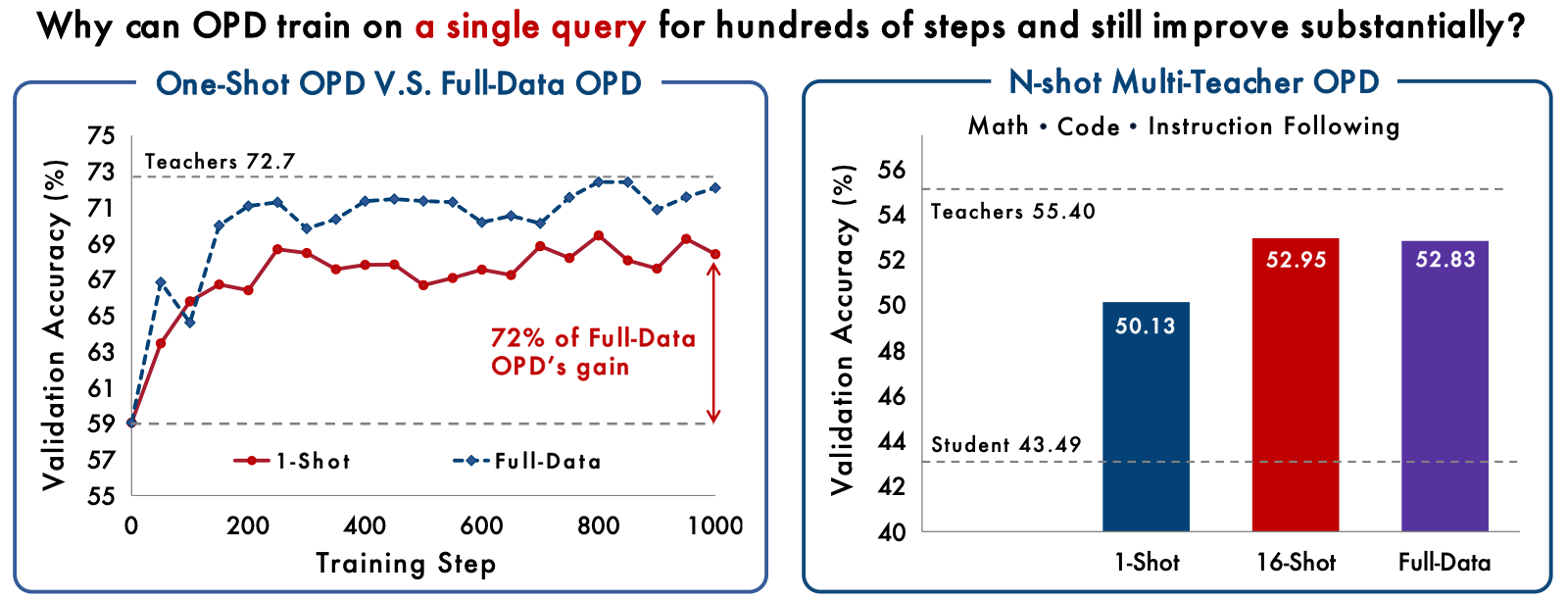
Rethinking On-Policy Distillation of Large Language Models II: One Training Example looks at that gap at its most extreme, with a single training example. Zixuan Fu, Bingxiang He, and 11 coauthors, most of them at Tsinghua University, posted version 1 (29 pages) on arXiv on September 3, 2026. They trained a small student model on a single question for hundreds of steps, and according to the paper, the student recovered most of the gain of full-data training across four task domains and three model families. The authors explain that one question already takes the student into a wide enough range of situations, while the rate at which it absorbs the teacher’s signal slows down at a similar pace whatever the amount of data. That’s why they call on-policy distillation “data-overfed but algorithm-starved” throughout the paper.
As of November 2, 2026, the paper has 82 upvotes on Hugging Face Daily Papers, and it’s the second part of a series after a first part (April 2026) that studied when on-policy distillation succeeds or fails. It also arrived while several papers were probing the same method, such as Does On-Policy Distillation Really Distill?, posted a few days earlier.
Distillation, from the teacher’s answers to the student’s own
The name distillation comes from Hinton, Vinyals, and Dean’s 2015 paper Distilling the Knowledge in a Neural Network. A small student model learns the right answer along with a large teacher model’s probabilities, which they call soft targets. Just as “most likely a cat, a little like a dog” tells you more than the bare label “cat,” soft targets that are spread out carry much more information per training case.
For language models, there are two broad ways to do this. Off-policy distillation has the student imitate answers the teacher wrote, much like supervised fine-tuning (SFT). The catch is that once the student writes on its own, it soon wanders into half-finished sentences it never saw in training. GKD (Agarwal et al., ICLR 2024) calls this a train-inference distribution mismatch and trains the student on its own samples instead. That’s on-policy distillation (OPD). The teacher supplies its next-token distribution at every position of the student’s answer, so every token gets a signal. The paper contrasts this dense supervision with the single end-of-answer reward of reinforcement learning with verifiable rewards (RLVR).
The objective is a per-token KL divergence with the student’s distribution first and the teacher’s second, which GKD calls reverse KL. Let’s make up some numbers. Say that after “2 + 3 =”, the student gives “6” a 30% chance while the teacher gives it 2%. The paper’s per-token score is the teacher’s log-probability minus the student’s, so writing “6” earns -2.71. Reverse KL weights each token by the student’s probability, so “6” alone adds 0.81 to it. Forward KL, which is what imitating teacher-written text lowers on average, weights by the teacher’s 2%, so the same “6” counts for only -0.05. So OPD presses hardest on the mistakes the student actually tends to make.
The question and the experimental setup
The direct inspiration was one-shot RLVR, where reinforcement learning on a single math problem lifted Qwen2.5-Math-1.5B on MATH500 from 36.0% to 73.6%. This paper runs the same test for OPD and calls it one-shot OPD. Each student is paired with a post-trained teacher from the same family, and the main math pair is DeepSeek-R1-Distill-Qwen-1.5B as the student and JustRL-1.5B as the teacher. The code, instruction-following, and agentic tool-use runs use other 1.5B pairs, and the authors added math pairs built on Llama-3.2-3B and OLMo-3-7B. The single math question is one of three from DAPO-Math-17K that the student had solved 8, 4, and 0 times out of 8 before training. Every update uses 64 rollouts sampled from the student, and math scores average MATH-500, AMC 2023, and AIME 2025.
How much one question recovered
The paper reports progress as ratios. Gap recovery is the share of the teacher–student gap the student closed, and full-data recovery divides by the gain that full-data training achieved at the same step. Here are the comparisons I picked, each between runs with the same number of steps and 64 rollouts per update.
| Comparison | Reported result | Section |
|---|---|---|
| Math, one question vs full data, step 300 (top-16 objective) | 68.5 vs 69.8, 87% of the full-data gain | 3.2 |
| The same runs at step 1000 | 68.4 vs 72.1, 72% of the full-data gain | 3.2 |
| Math, one question vs full data, step 300 (sampled-token objective) | 66.9 vs 70.8, from 59.1 | 4.1 |
| Code, instruction following, tool use, one question each | 73%, 66%, 64% of the teacher–student gap | 3.2 |
| State coverage at step 300, one question vs 16 questions | 71.5% vs 98.9% | 4.1, 4.2 |
| Three-teacher OPD at step 300, 1 vs 16 questions per domain vs full data | 50.1 vs 52.9 vs 52.8, from 43.5 | 6 |
The headline 87% comes from the Section 3 math runs, which used a top-16 objective that sums over the student’s 16 most likely tokens. In the Section 4 runs with the sampled-token objective, by my arithmetic, one question delivered 7.8 of full data’s 11.7 points, about two-thirds. So the exact share depends on which run you read. The paper also reports that the hard question, which the student never solved in 300 steps, helped about as much as the easy one.
State coverage, why one question goes so far
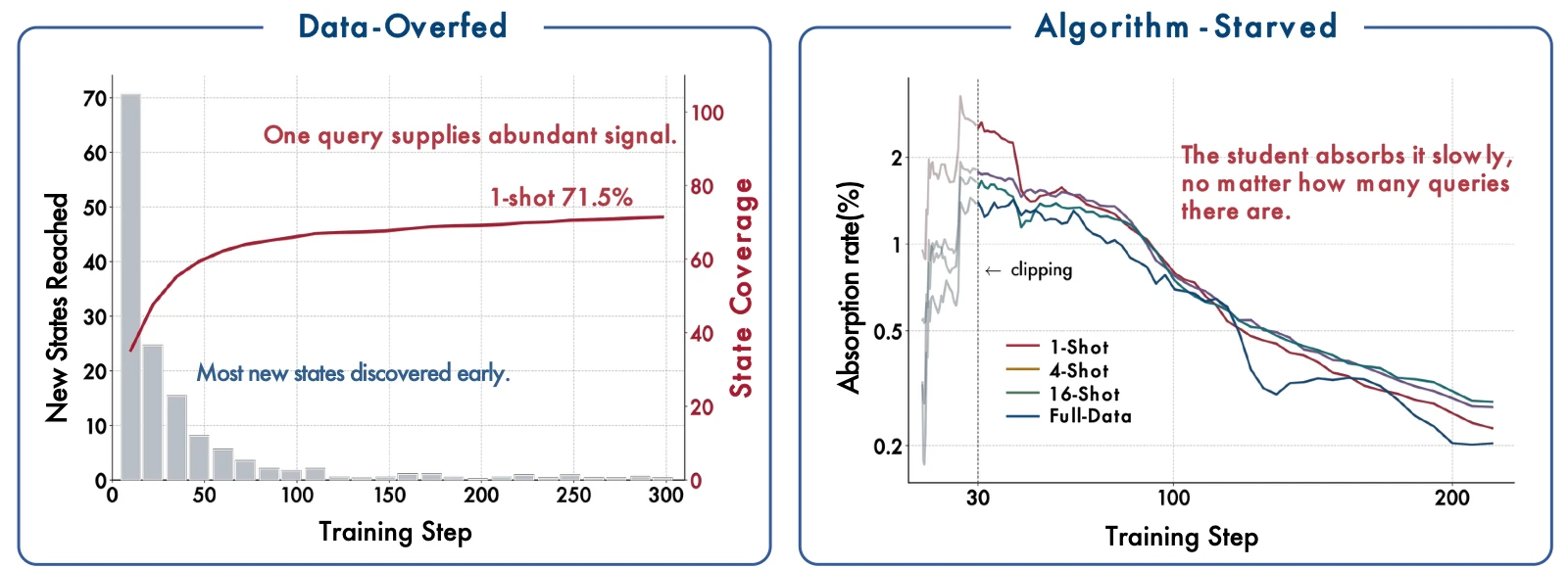
The first explanation changes what gets counted. OPD learns from states, and a state is the question plus whatever the student has written so far. Every token the student writes creates one, so with 64 rollouts per update even a single question yields “tens of thousands of supervised states,” in the authors’ words. To measure breadth, the authors represent the states that full-data OPD visits by the teacher’s final-layer hidden vector and group them into 200 clusters with PCA and K-means. State coverage is the share of those clusters a run’s states land in.
One question reached 71.5%, roughly 143 of the 200 clusters, and it was already at 65.9% by step 100. Adding semantically distinct questions raised coverage to 79.8% with 4 and 98.9% with 16 (Table 4), and at 16 the accuracy matched full data too. Spread mattered more than count, since 16 questions drawn from a single semantic cluster flattened near 76.8% (Appendix B.2).
To see this in motion, I wrote a tiny toy. It’s a small example of the principle, not a reproduction of the paper. The teacher picks the next of 8 tokens from a fixed table keyed by the last two tokens, and the student is a table of the same shape with different starting values. The 64 possible pairs of two tokens serve as the toy’s clusters, called contexts below. Each step, the student writes 64 continuations of 4 tokens and lowers the reverse KL to the teacher on every state it visited.
import torch
V, L, B = 8, 4, 64                    # vocab size, tokens per rollout, rollouts per step
g = torch.Generator().manual_seed(0)
teacher = torch.log_softmax(2 * torch.randn(V, V, V, generator=g), -1)  # next token given last two
start = 2 * torch.randn(V, V, V, generator=g)                           # student's initial logits
prompts = torch.tensor([[a, b] for a in range(V) for b in range(V)])    # all 64 two-token prompts

def opd(n_prompts, steps, show):
    torch.manual_seed(0)
    logits = start.clone().requires_grad_()
    opt = torch.optim.Adam([logits], lr=0.05)
    states, contexts = set(), set()
    for step in range(1, steps + 1):
        seqs = prompts[:n_prompts][torch.randint(n_prompts, (B,))]
        for _ in range(L):            # the student writes its own continuation
            probs = torch.softmax(logits[seqs[:, -2], seqs[:, -1]], -1).detach()
            seqs = torch.cat([seqs, torch.multinomial(probs, 1)], 1)
        a, b = seqs[:, :L].flatten(), seqs[:, 1:L + 1].flatten()     # last two tokens of each state
        states |= {tuple(s[:i]) for s in seqs.tolist() for i in range(2, L + 2)}
        contexts |= set(zip(a.tolist(), b.tolist()))
        logp = torch.log_softmax(logits[a, b], -1)
        loss = (logp.exp() * (logp - teacher[a, b])).sum(-1).mean()  # reverse KL per visited state
        opt.zero_grad(); loss.backward(); opt.step()
        if step in show:
            lq = torch.log_softmax(logits.detach(), -1)
            gap = (lq.exp() * (lq - teacher)).sum(-1).mean()        # averaged over all 64 contexts
            print(f"{n_prompts:2d} prompt(s), step {step:3d}: states {len(states):4d}, "
                  f"contexts {len(contexts):2d}/64, gap {gap:.3f}")

for n, show in [(1, {1, 10, 100, 300}), (64, {10, 300})]: opd(n, 300, show)
1 prompt(s), step 1: states 38, contexts 33/64, gap 2.556
1 prompt(s), step 10: states 128, contexts 61/64, gap 2.238
1 prompt(s), step 100: states 362, contexts 64/64, gap 0.197
1 prompt(s), step 300: states 423, contexts 64/64, gap 0.014
64 prompt(s), step 10: states 1148, contexts 64/64, gap 2.057
64 prompt(s), step 300: states 8952, contexts 64/64, gap 0.002Even with one prompt, the student’s own sampling carried it to 33 of the 64 contexts in the first step and 61 by step 10, and the number of distinct states grew from 38 to 423. At step 300, its gap to the teacher was 0.014, close to the 0.002 of the 64-prompt run. Of course, the toy is so small that one prompt eventually reaches every context, whereas the paper’s single question stopped at 71.5%. Nothing guarantees, either, that a real model carries what it learns between states as neatly as this table does. Yet at step 10, when nearly every context had already been visited, the gap was still 2.238. Reaching states and absorbing the teacher’s signal there are separate matters, which leads to the second explanation.
Alignment slows the same way with any amount of data
The authors measure two things on the states the student visits. Distance is the average size of the per-token gap between the teacher’s and the student’s log-probabilities, and absorption rate is the share of the remaining distance that one update removes. If one update takes the distance from 1.00 to 0.98, the absorption rate is 2%. Runs on 1, 4, 16, and all of the DAPO-Math-17K questions each removed 78% to 84% of their distance between step 30 and step 300 (Table 7). Yet the absorption rate kept falling, by a factor of 5.6 for one question and 6.4 for full data between steps 50 and 200. The authors therefore call the pace “a property of OPD rather than of the training set,” and two controls point the same way. A run that kept reusing 64 trajectories sampled once from the initial student still gained accuracy for about 200 steps, so a run doesn’t last long because fresh states keep arriving. And changing the learning rate only stretched or squeezed the step axis (Appendix C.2).
That’s what “data-overfed but algorithm-starved” means. The rollouts expose more teacher supervision than the student can use, and early on, while each update absorbs a smaller share of what’s left. So the authors hope future work will turn to OPD’s step efficiency, meaning how much a single update can take in.
Multiple teachers and content-free inputs
In MOPD, where one run uses three teachers for math, code, and instruction following, 16 diverse questions per domain reached 52.9 against 52.8 for full data. Inputs that state no problem, such as an empty user turn that only opens the thinking block or general WildChat conversations, also tracked the real-question baseline in math. Of course, the authors add that this alone doesn’t make task content generally dispensable.
Limitations and how far to trust the results
As of November 2, 2026, this is an arXiv preprint at version 1, and its arXiv page lists no conference or journal. The authors name three limitations. State coverage is a proxy measured against full-data rollouts, and it weights every cluster equally. What sets the absorption rate is still open. And MOPD used only three domains with one teacher each. The setup matters too. The students are 1.5B to 7B, the teachers are post-trained models of the same family, and the coverage error bars reflect rollout subsampling rather than variation across trained models. Training on one question still needs 64 rollouts per update, hundreds of steps, and a teacher scoring every token. So the paper’s own takeaway is narrower than “one example is enough.” It says data for OPD should be chosen by which states an input induces, more than by how many problems are collected.
Code, models, and where to start reading
The code is at Thinking-Space/One-Shot-OPD under the Apache License 2.0. It’s built on veRL, and MODE=oneshot bash recipe/opd.sh runs one-shot OPD. According to the README, no dataset ships with it, and its reference numbers come from a single node of 8 H100 or A100 80 GB GPUs. The paper’s Hugging Face collection holds one model, the instruction-following teacher UltraData-IF-1.5B, whose card lists its license as other. In the paper, I’d start with Section 4.1 for coverage and Section 5 for the absorption rate, then check Appendices B.1 and C.1 for how they were measured. I ran the toy above on November 2, 2026, with Python 3.13.12 and PyTorch 2.15.0 on a CPU.
AI tools helped with the research for this post.