AI paper reviews › Multimodal and world models
The OpenWAM paper explained, what world action models need
OpenWAM splits world action models into swappable parts, tests which choices matter, and trains OpenWAM-α on about 6,400 hours of human and robot video.
If you’ve followed robotics news this year, you’ve probably seen clips of robot arms stacking blocks or putting away clothes, often alongside talk of world models. Once video generators became good at imagining the next moments of a scene, people began building models that use that ability to move robots. These are called world action models, or WAMs. The trouble is that each new WAM changes many things at once, so it’s hard to tell which of those changes actually helped.
OpenWAM is a paper that tries to sort this out. The authors split a WAM into parts that can be swapped one at a time (OpenWAM-Infra), then ran controlled experiments on top of it and boiled the results down to three principles (OpenWAM-Study). Following those principles, they pretrained OpenWAM-α on about 6,400 hours of first-person human video and robot data and tested it on eight simulation benchmarks and on real robots with one arm, two arms, and a dexterous hand. They released the code and the weights as well.
The paper is titled OpenWAM: An Open, Modular Exploration Towards Systematic World-Action Model Pretraining. It was posted to arXiv on September 7, 2026 as version 1, and its 24 authors come from seven institutions, including the National University of Singapore and Tsinghua University. It drew attention quickly, and as of November 2, 2026, it had 73 upvotes on Hugging Face Daily Papers and more than 1,100 stars on GitHub.
World models, VLAs, and WAMs
A world model is a model that learns how the world changes over time. A vision-language-action model, or VLA, starts from somewhere else. RT-2, which named this category in 2023, took a vision-language model trained on web images and text and taught it to output robot actions as text tokens. So a VLA inherits knowledge about what things are and what words mean. A WAM instead starts from a video generation model and predicts future frames and actions together. In the words of DreamZero, WAMs learn physical dynamics by predicting future world states and actions.
As for why this direction is drawing attention now, the OpenWAM paper points to an asymmetry in data. Videos of the world changing are abundant, but robot recordings with executable action labels are comparatively scarce. So the hope is that a robot can borrow what video models learned about motion from the abundant side, and then learn its actions from far fewer demonstrations.
A few unfamiliar terms are worth pinning down with numbers. Denoising is a way of generating that starts from pure noise and cleans it up a little at a time, and OpenWAM-α uses 10 steps. A latent space is the compressed form the model works in. After the first frame, OpenWAM-α’s encoder folds every four frames into one, so a 33-frame clip becomes 9 latent frames with 48 numbers at each position. Egocentric video is first-person footage of people working with their hands, so it carries no robot action labels. And an embodiment is the robot body that carries out the actions, and each body describes its actions with a different set of numbers.
The data problem in a toy world
I wanted to see that asymmetry for myself, so I built a toy world. It’s a small example to show the principle, not a reproduction of the paper. A robot dot and a goal dot sit on a plane. Their four coordinates, together with 16 numbers of background clutter that change every frame, pass through a random “camera” that mixes them into 40 pixels, and some noise is added. There are 2,000 videos without action labels and only a handful of demos. The action-only model learns from the demos alone. The world+action model also learns from the videos to predict the next frame through an 8-number latent, and its action side reads that latent.
import torch, torch.nn as nn
torch.manual_seed(0)
CAMERA = torch.randn(20, 40)  # 4 state numbers + 16 clutter numbers -> 40 pixels

def clips(n):
    robot, goal = torch.rand(n, 2) * 2 - 1, torch.rand(n, 2) * 2 - 1
    action = goal - robot  # the demonstrator heads straight for the goal
    def look(pos):  # clutter changes every frame, and the camera adds noise
        return torch.cat([pos, goal, torch.randn(n, 16)], 1) @ CAMERA + 0.3 * torch.randn(n, 40)
    return look(robot), action, look(robot + 0.1 * action)

def action_error(n_demos, sees_world, seed):
    torch.manual_seed(seed)
    video_now, _, video_next = clips(2000)  # plenty of video, no action labels
    (demo_now, demo_action, _), (test_now, test_action, _) = clips(n_demos), clips(1000)
    world, decode = nn.Linear(40, 8), nn.Linear(8, 40)  # world stream with an 8-number latent
    head = nn.Linear(8 if sees_world else 40, 2)
    act = (lambda x: head(world(x))) if sees_world else head
    opt = torch.optim.Adam([*world.parameters(), *decode.parameters(), *head.parameters()], lr=0.01)
    for _ in range(1500):
        loss = ((act(demo_now) - demo_action) ** 2).mean()  # only the labeled demos
        if sees_world:  # one stage: video trains only the world stream, demos train both
            loss = loss + ((decode(world(video_now)) - video_next) ** 2).mean()
        opt.zero_grad(); loss.backward(); opt.step()
    return (act(test_now) - test_action).abs().mean().item()

print(f"stand still: {clips(1000)[1].abs().mean():.3f}\ndemos  action-only  world+action")
for n in [10, 30, 100, 300]:
    a, b = (sum(action_error(n, s, seed) for seed in range(5)) / 5 for s in (False, True))
    print(f"{n:5d}  {a:11.3f}  {b:12.3f}")
I ran it on a CPU with PyTorch 2.15.0. Each number is the mean action error on 1,000 test frames, averaged over 5 seeds.
stand still: 0.653
demos  action-only  world+action
   10        1.412         0.237
   30        0.198         0.102
  100        0.083         0.080
  300        0.070         0.073
An error of 0.653 is what you’d get if the robot simply stood still. With 10 demos, the action-only model overfits by explaining the demos with clutter and noise, so it does even worse at 1.412, while the world+action model gets 0.237. The world side can only predict what is predictable, so its latent ends up holding mostly the robot and the goal, and the action side only has to learn a simple mapping from there. Once there are 100 demos or more, though, the gap disappears, and at 300 the action-only model is slightly ahead. Of course, this toy proves nothing about real robots. It only shows why video without action labels can help when demos are scarce.
Taking a WAM apart into swappable parts
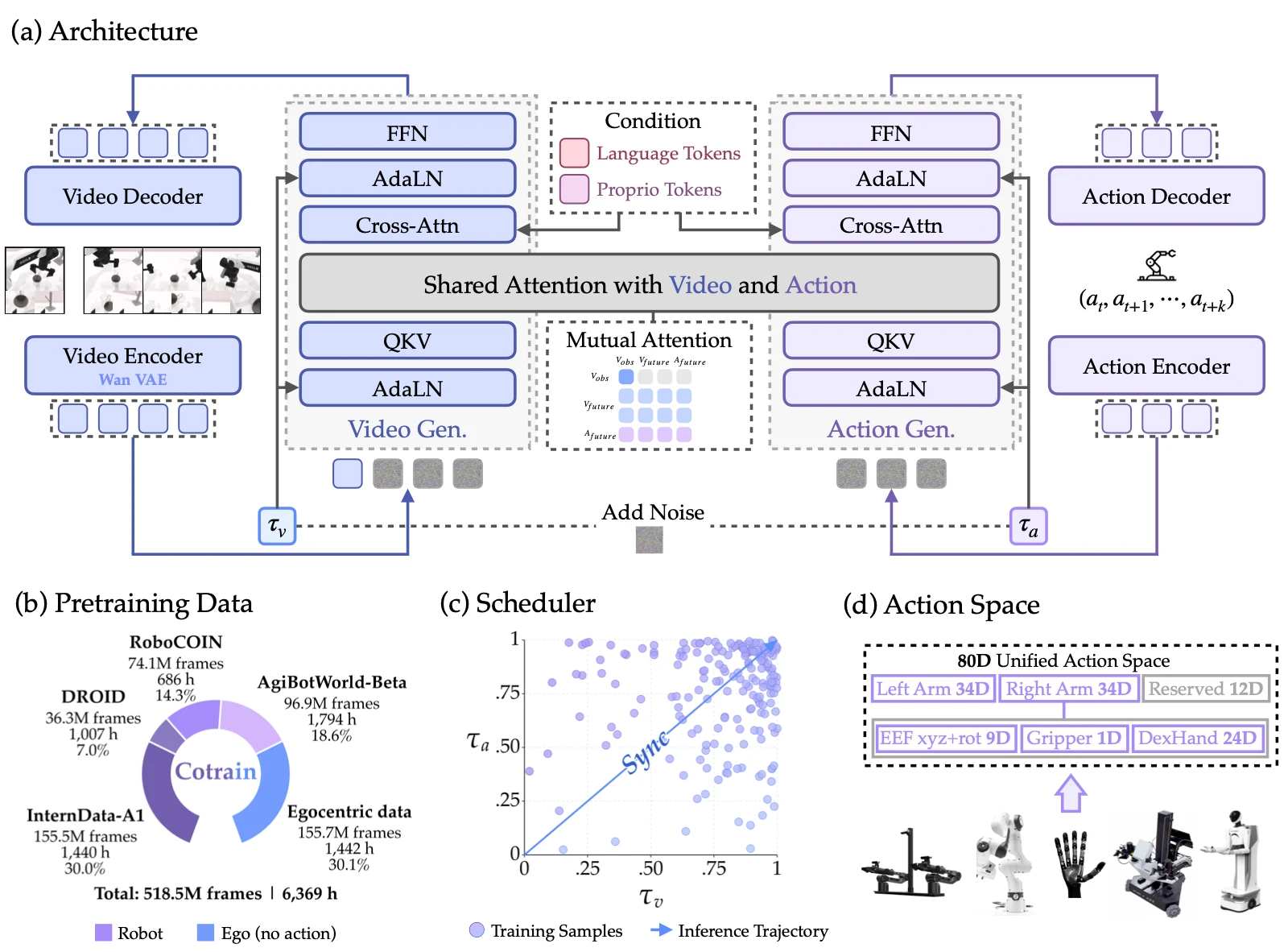
The paper’s starting complaint is that existing WAMs are monolithic. The generative backbone, the visual representation, the architecture, the information flow, the inference procedure, and the training data are tied together, so when one system wins, you can’t tell what earned the win. That’s why OpenWAM-Infra splits a WAM into three kinds of parts. A visual encoder turns images into latents, backbones such as a video stream and an action stream predict future frames and a chunk of upcoming actions, and an attention mask decides which tokens may look at which. Combining them yields six architectures, and every one of them runs on the same trainer and the same policy server.
The unified action space is worth a closer look too. OpenWAM fixes actions to 80 slots. Each of two arm blocks has 34 slots, made of a position (3), a rotation (6), a gripper (1), and a dexterous hand (24), and the remaining 12 slots are for signals such as a mobile base. An arm with a simple gripper fills only 10 slots, and a mask keeps the empty ones out of training. In egocentric video every action slot is masked, so it trains only the video side.
Three questions and the principles they produced
The authors asked, in order, what a WAM should inherit, how world and action learning can help each other, and how that help carries across domains. The experiments are scored by success rate on RoboTwin2.0, a two-arm simulation benchmark spanning over 50 tasks. Its Clean2Random setting trains on clean scenes only and then tests on randomized scenes as out-of-domain.
What to inherit, a capable backbone and a compact latent
Swapping only the video generation backbone gave average success rates on RoboTwin2.0-Full of 90.14 at 1.3B parameters, 91.64 at 2B, 92.39 at 5B, and 93.79 at 14B (Figure 6). The 5B model trailed by only 1.40 points, so it became the default, and since the backbones also differ in architecture and data, the authors don’t credit the gap to size alone. The latent space mattered as well. With the video network’s weights randomly initialized so that only the representation differed, DINOv3’s 768-number features scored 76.42, but shrinking them to 48 numbers with an adapter called S-VAE brought that to 90.18, almost level with Wan2.2-VAE’s 90.30 (Figure 7). So the authors conclude that what matters is less the kind of encoder than whether the latent is compact and rich in information about the world.
How world and action learning help each other
First, actions need their own capacity. The two single-system variants scored 85.50 and 84.63, while the best dual-system variant, which gives actions their own network and joins the two through self-attention, reached 92.36 and the tri-system model, which adds a vision-language model, 92.60 (Table 1). Second, the action stream must be able to see the world stream. Masks that blocked that path scored 87.41 and 87.63, and masks that opened it scored 92.39 and 92.15 (Table 2). That’s the same lesson as the toy above.
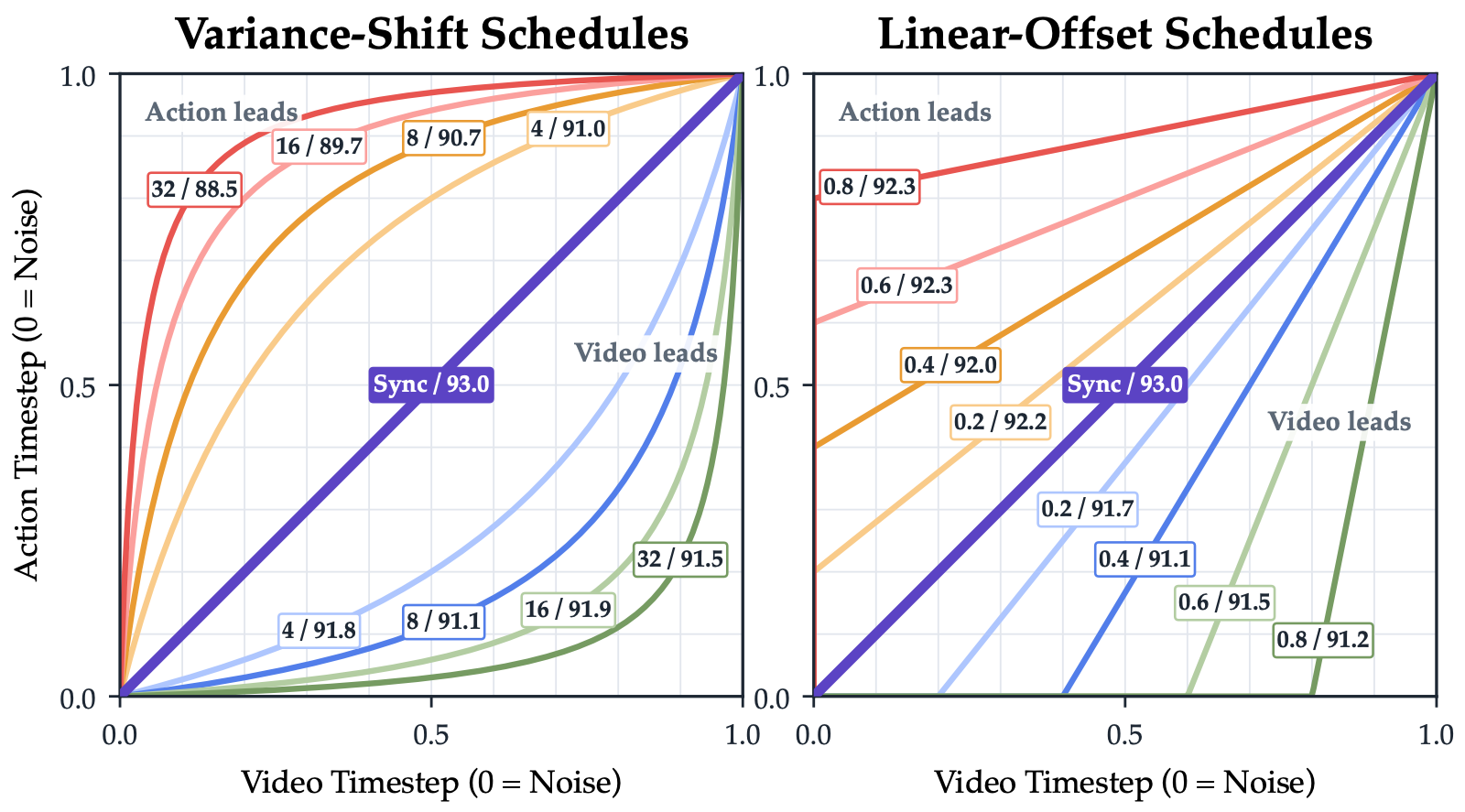
Third, the two streams should be denoised in step. The authors tried 16 schedules that clean one stream ahead of the other. With an offset of 0.4, for example, the lagging stream is still pure noise for the first 40% of the steps. None of them beat the synchronized schedule’s 93.0, and the best reached 92.3 (Figure 9). The authors read this as support for the view in Fast-WAM that the value of video prediction lies more in the representations built during training than in imagining the future.
Pretraining mostly helps outside the training distribution
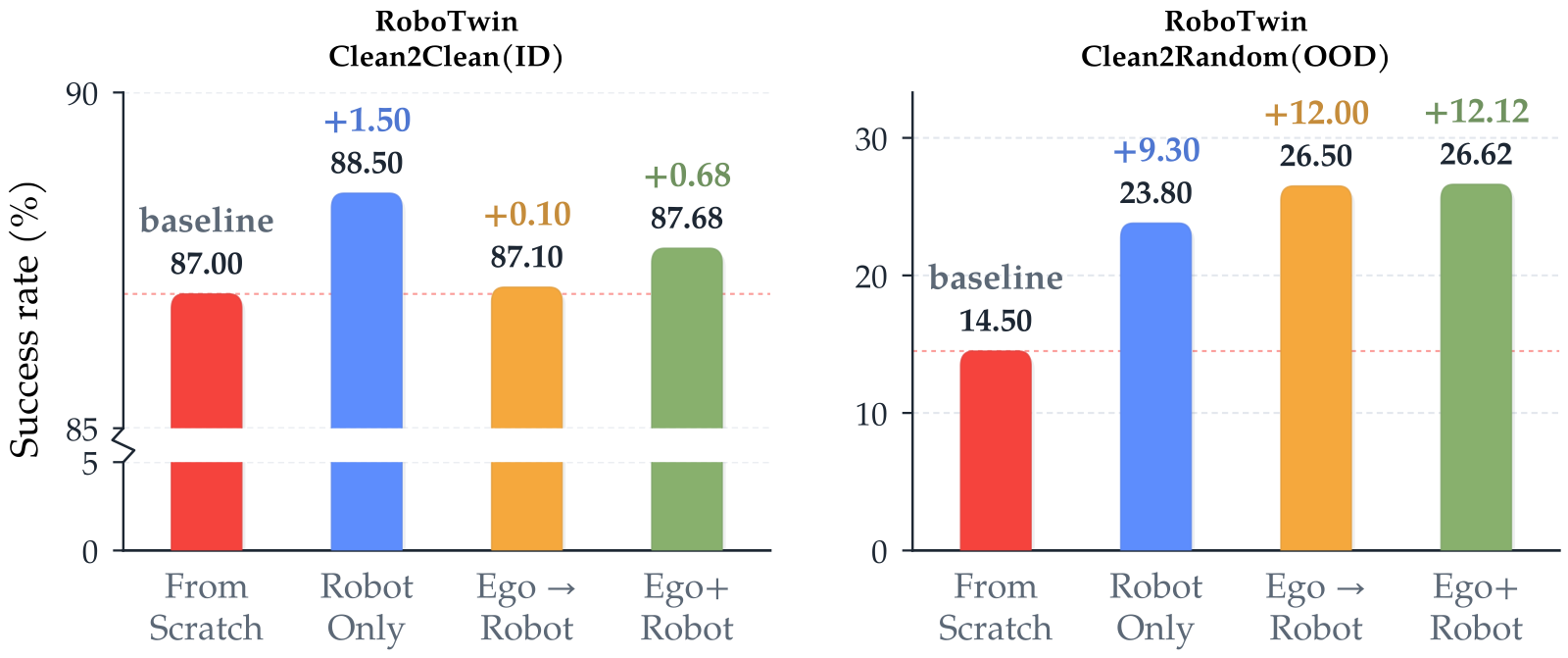
With the same 600-hour budget, the authors compared training from scratch, using robot data only, and mixing 350 hours of egocentric video with 250 hours of robot data in either two stages or one. After the same fine-tuning, in-domain success barely moved, from 87.00 to between 87.10 and 88.50. On randomized scenes the model had never seen, though, 14.50 rose to 23.80 with robot data only and to 26.62 with the one-stage mix (Figure 10). So, according to the paper, embodied pretraining mainly improves out-of-domain generalization, with robot data anchoring the actions and egocentric video widening what the model has seen. The simpler one-stage mix became the default, and after pretraining the two-way mask edged out the one-way mask by less than a point (Figure 11).
OpenWAM-α and what it scored
OpenWAM-α brings these principles together. A 5B video network initialized from Wan2.2-TI2V-5B and a 1B ActionDiT share attention in both directions at all 30 layers, and they were trained in one stage on 518.5M frames, or 6,369 hours (Table 4). Egocentric video and simulated data make up about 30% each, and real robot data about 40%. The model was then fine-tuned for each benchmark (LIBERO-Plus uses the LIBERO checkpoint), and below are success rates in percent next to the strongest other model in the same table.
| Benchmark (paper table) | OpenWAM-α | Strongest other in the table |
|---|---|---|
| LIBERO, one arm (Table 13) | 99.3 | 99.4, ABot-M0.5 (WAM) |
| RoboTwin2.0-Full, two arms (Table 16) | 93.60 | 94.10, ABot-M0.5 (WAM) |
| RoboTwin2.0-Clean2Random (Table 15) | 69.0 | 77.1, Qwen-RobotManip (VLA) |
| LIBERO-Plus, perturbed scenes (Table 5) | 69.2 | 89.0, Qwen-RobotManip (VLA) |
| EBench, mobile two arms (Table 18) | 49.4 | 45.6, Qwen-RobotManip (VLA) |
| Real Franka arm, 6 tasks (Table 6) | 82.5 | 77.5, LingBot-VA (WAM) |
On RoboDojo’s real two-arm track, its progress score and success rate were 37.6 and 24.4 against 22.9 and 12.8 for π0.5, and on a dexterous hand absent from pretraining it also beat π0.5 on all four tasks (Table 7, Table 8). Its weak spot is LIBERO-Plus, where it scored 33.8 under camera changes and 39.8 under added noise (Table 5). The authors attribute this to having only a little over 1,100 hours of single-arm pretraining data and to a pixel-level latent that is sensitive to camera and noise.
The models in the table differ in data and architecture, so the authors don’t declare either VLAs or WAMs better outright. Without embodied pretraining, though, the WAM Fast-WAM beat the VLA StarVLA on clean in-domain scenes, 77.8 to 46.5, and trailed it on LIBERO-Plus, 51.5 to 74.1 (Figure 16). The authors explain that predicting video helps a model fit its training data, but once the scene shifts, errors pile up when predicting far into the future.
Limitations and what we don’t know yet
This is an arXiv preprint, and the arXiv page lists no journal or conference. In their limitations section, the authors say they mostly studied the pretraining phase, left out UMI-style data, and found that the Wan2.2-VAE latent doesn’t hold up well against changes in viewpoint, noise, and scene. The experimental design calls for some care too. All the controlled studies ran on a single benchmark, RoboTwin2.0, and the paper reports single numbers without the spread across repeated runs, so small gaps such as 92.39 against 92.15 are hard to judge. And while the robot datasets have been released in cleaned form, I couldn’t find the authors’ own egocentric dataset of 71.6K recordings on Hugging Face as of November 2, 2026. That’s why reproducing the exact pretraining data may not be possible yet.
Code, weights, and where to start
The code is under the Apache License 2.0, and the paper under CC BY 4.0. The OpenWAM organization on Hugging Face hosts 46 model repositories tagged Apache-2.0. They include the pretrained model, the fine-tuned checkpoints for each benchmark, and the checkpoints from the comparison experiments, and the results and robot videos are collected on the project page.
For the paper itself, I’d start with Section 4, its recipe in Table 3, and the limitations in Appendix A. If you’d like to try the model, the foundation checkpoint is a single file of about 24.8 GB, and the README’s quick start fine-tunes it on LIBERO with a recommended 8 GPUs of 80 GB each.
AI tools helped with the research for this post.