AI paper reviews › Agents
RRSI paper review, curbing overfitting in harness evolution
How the RRSI paper from Google researchers keeps self-improving agent harnesses from memorizing their tasks, how its regularizers work, and what it reports.
If you’ve followed AI agents this year, you may have seen the phrase recursive self-improvement attached to harnesses, and not only to models. The model stays frozen, and an LLM keeps rewriting the prompts and code around it, holding on to whatever scores better on a benchmark. But in September 2026, HarnessDev reported that such gains were unstable and only partly carried over to held-out tasks, and ModularRSI built 2,000 evolution tasks kept apart from the benchmarks it was tested on. The worry is that a harness tuned against one benchmark may simply be memorizing that benchmark.
RRSI: Regularized Recursive Self-Improvement of Agent Harnesses takes that worry head on. It was written by Peng Xia and 13 coauthors, most of them at Google Cloud AI Research. It first went up on arXiv on September 21, 2026, and I read v3, posted October 4. The authors borrow regularization from machine learning to constrain both the step that proposes harness edits and the step that picks them. Across eight benchmarks, they report gains of up to 6.0 points on the split the harness evolved on, gains on every held-out split, and a harness that uses fewer policy tokens than evolution without the constraints. As of November 2, 2026, it had 174 upvotes on Hugging Face Daily Papers, and its code repository had 1,696 GitHub stars.
The loop that rewrites a harness
The paper treats the harness as everything except the weights. Prompts, control flow, tools, memory and skill files, and the context management that picks what the model sees at each step all belong to it. In harness evolution, the current harness runs a fixed set of tasks called the evolve set. An LLM proposer then reads the results and drafts candidate harnesses, the candidates run the same tasks, and the top scorer becomes the next harness. Since the system uses its own feedback to rewrite its own program, the authors call this recursive self-improvement (RSI) at the agent-system level.
Why reusing the same tasks turns into memorizing them
The trouble is that the same evolve set gets reused adaptively. Each candidate is drafted after seeing how earlier candidates scored on those very tasks, so the score stops being an independent check. That’s why, the authors argue, a harness collects benchmark-specific patterns, changes that won by evaluation noise, and complexity that only lifts the score.
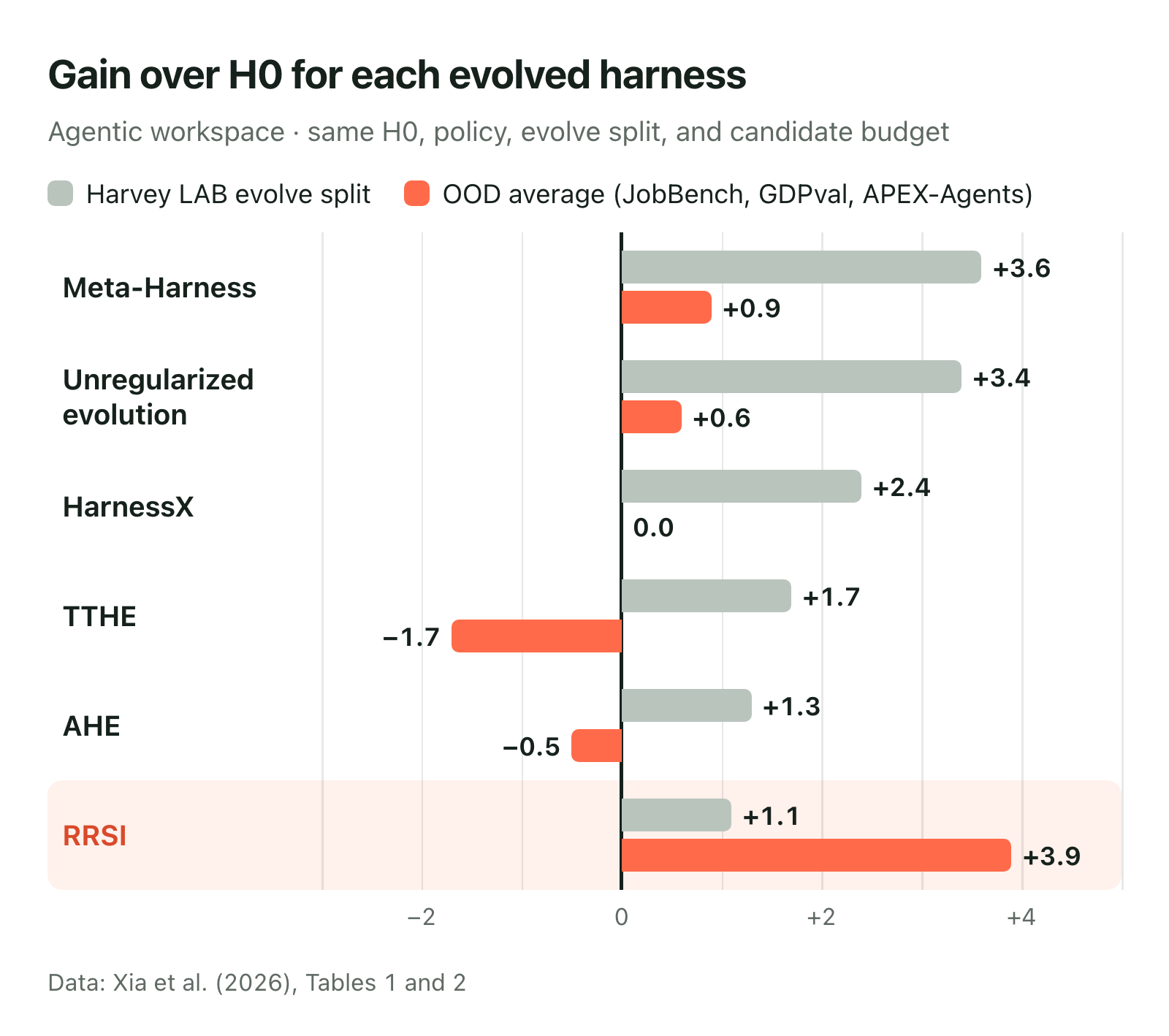
Appendix F shows what earlier methods left in the harness after evolving on Harvey LAB, a legal-work benchmark. Meta-Harness ended with a 730-word work method that restated how the suite is graded. It scored highest on the evolve split, yet added only 0.9 points out of distribution. TTHE piled up roughly 8,500 words of protocol blocks, about 1,000 of them only for redline documents, a genre of the evolve suite, and it ended 1.7 points below where it started. Neither harness names a task, so a keyword check wouldn’t catch either one.
Constraints on the proposer
RRSI leaves every component editable and puts its constraints on how the search moves. Figure 2 of the paper gives an overview of the constraints on both the proposing and the selecting side. The first constraint is an edit budget that shrinks over time. The number of edits one candidate may bundle, b_t, falls along a cosine curve from b_max to b_min (Equation 4), so later rounds make it easier to tell which edit caused a score change. The paper likens it to L0 regularization, which caps how many parameters may be nonzero. When I put the agentic workspace setting (T = 20, b_max = 3, b_min = 1, Table 5) into Equation 4, it allowed 3 edits in rounds 0 to 9 and 2 in rounds 10 to 19. Second, the proposer reads a history of every evaluated candidate’s hypothesis, diff, score and cost change, and verdict, so it doesn’t repeat ideas already rejected. Third, if progress over the last w = 3 rounds stays within the noise band, one of the two candidate slots goes to components the run hasn’t touched yet, which the paper compares to diversity or entropy regularization.
The gates a candidate must pass
On the selection side, a candidate that fails even one gate is out, however high its score. The first gate is the critic. Before any evaluation, it reads the diff and rejects edits carrying content specific to the evolve benchmark, such as task names, entity names, or answers. Filtering before scoring keeps an inflated score from becoming a foothold for later rounds. The second is a noise floor. The authors evaluate the unchanged base harness repeatedly and take the spread of its scores as δ, which on the coding benchmark is 0.017, or 3 passes out of 178 trials. A candidate may not fall more than δ below the best score so far, so small drops that each look like noise can’t pile up into a slide.
The third gate is a cost rule. When a gain clears δ, the growth in policy tokens must stay under β0 + β1 × gain. In Appendix E.1’s coding example, a candidate worth 7 extra passes is allowed 10 + 7 × 25 = 185% more tokens, so its measured growth of 130% is accepted, while one worth a single pass is allowed only 35%. The paper compares this to Ridge (L2) regularization, which holds down the overall size of a solution. Last, the pruner hands the proposer, as deletion targets, any component that showed no positive gain within a pruning window of 4 or 5 rounds, and the paper compares this to Lasso (L1), where weak features drop out entirely. Of course, as Appendix D says, these are only analogies of role, and no norm penalty is directly optimized.
A small simulation without an LLM
To see the gates at work, I wrote a small simulation with no LLM in it. It doesn’t reproduce the paper and only shows the principle. The harness is a few string rules plus a table of memorized answers, and the job is to tidy spaces and lowercase the text. Only the held-out tasks contain digits, so a rule that deletes digits shows no cost on the training score.
import math, random, re

RULES = {"strip": str.strip, "lower": str.lower, "upper": str.upper,
         "squeeze": lambda s: re.sub(" +", " ", s),
         "nodigit": lambda s: re.sub("[0-9]", "", s)}
target = lambda s: " ".join(s.split()).lower()  # the job: tidy spaces, lowercase
train = ["Hello World", "good  morning", " red fox ", "BIG CAT", "tea   time", "  blue sky"]
held = ["room 42 ", "PIZZA FOR 2", "day 7  plan", "Late Night", " quiet room", "open  ai lab"]

def run(h, s):  # a harness: rules plus memorized answers
    if s in h["memo"]:
        return h["memo"][s]
    for name, rule in RULES.items():
        if name in h["rules"]:
            s = rule(s)
    return s

def score(h, tasks):
    return sum(run(h, s) == target(s) for s in tasks)

def apply(h, edits):
    new = {"rules": set(h["rules"]), "memo": dict(h["memo"])}
    for kind, x in edits:
        if kind == "memo":
            new["memo"][x] = target(x)  # memorize the answer
        else:
            new["rules"] ^= {x}  # add the rule, or remove it
    return new
Unregularized evolution proposes 4 random edits per round (about half memorize an answer) and keeps the candidate if the training score rises. The regularized version adds a budget that falls from 4 to 2, a critic that drops memorizing edits, and a pruner that removes any rule whose removal leaves the training score unchanged.
def propose(h, rng, n):  # about half memorize an answer
    failing = [s for s in train if run(h, s) != target(s)]
    return [("memo", rng.choice(failing)) if failing and rng.random() < 0.5
            else ("toggle", rng.choice(list(RULES))) for _ in range(n)]

def evolve(arms, rounds=12, seed=0):
    rng, h, log = random.Random(seed), {"rules": set(), "memo": {}}, []
    for t in range(rounds):
        b = math.ceil(1 + 1.5 * (1 + math.cos(math.pi * t / rounds)))  # 4 down to 2
        n = b if "budget" in arms else 4
        edits = propose(h, rng, n)
        if "critic" in arms:  # critic: drop memorizing edits
            edits = [e for e in edits if e[0] != "memo"]
        cand = apply(h, edits)
        if score(cand, train) > score(h, train):
            h = cand
        for r in sorted(h["rules"]) if "prune" in arms else []:
            if score(apply(h, [("toggle", r)]), train) >= score(h, train):
                h = apply(h, [("toggle", r)])  # pruner: the rule adds nothing
        log.append((n, score(h, train), score(h, held)))
    return h, log

(_, log1), (_, log2) = evolve(()), evolve(("budget", "critic", "prune"))
print("round | unregularized train held | regularized budget train held")
for t, (a, b) in enumerate(zip(log1, log2)):
    print(f"{t:>5} | {a[1]}/6 {a[2]}/6 | {b[0]} {b[1]}/6 {b[2]}/6")
round | unregularized train held | regularized budget train held
0 | 2/6 0/6 | 4 0/6 0/6
1 | 3/6 0/6 | 4 2/6 2/6
2 | 5/6 4/6 | 4 2/6 2/6
3 | 5/6 4/6 | 4 2/6 2/6
4 | 6/6 2/6 | 4 4/6 4/6
5 | 6/6 2/6 | 3 4/6 4/6
6 | 6/6 2/6 | 3 6/6 6/6
7 | 6/6 2/6 | 3 6/6 6/6
8 | 6/6 2/6 | 2 6/6 6/6
9 | 6/6 2/6 | 2 6/6 6/6
10 | 6/6 2/6 | 2 6/6 6/6
11 | 6/6 2/6 | 2 6/6 6/6The unregularized run reached 6/6 on training in round 4, but in that same round its held-out score fell from 4/6 to 2/6. An edit that removed the squeeze rule rode along in the bundle that memorized the blue sky task, and since the training tasks with extra spaces had already been memorized, no loss showed up. The regularized run had to find rules instead, and it reached 6/6 on both sets in round 6. One seed can be luck, so I also ran each combination with 200 seeds.
for arms in [(), ("budget", "critic", "prune"), ("critic", "prune"), ("budget", "critic")]:
    hs = [evolve(arms, seed=s)[0] for s in range(200)]
    print("+".join(arms) or "unregularized", "| train", sum(score(h, train) for h in hs) / 200,
          "held", sum(score(h, held) for h in hs) / 200,
          "nodigit", sum("nodigit" in h["rules"] for h in hs))
unregularized | train 5.985 held 2.06 nodigit 96
budget+critic+prune | train 5.06 held 5.06 nodigit 0
critic+prune | train 5.16 held 5.16 nodigit 0
budget+critic | train 5.06 held 4.05 nodigit 79Compared with unregularized evolution, all three regularizers together lowered the training average from 5.985 to 5.06 and raised the held-out average from 2.06 to 5.06. Removing the budget, though, didn’t hurt at all (5.16 on both), perhaps because five rules leave little to untangle. Without the pruner, the digit-deleting rule survived in 79 of 200 runs, and the held-out average dropped to 4.05.
What the paper reports
In the main results, every number is compared against the unevolved harness H0 measured in the same window, with Claude Opus 4.8 as the policy. The table shows the agentic workspace domain, where every method ran from the same H0 with the same policy, evolve split, and candidate budget. The OOD average is the mean over JobBench, GDPval, and APEX-Agents, which the search never saw (Tables 1, 2, and 9).
| Harness | Harvey LAB evolve split | OOD average |
|---|---|---|
| H0, no evolution | 89.4 | 39.7 |
| Meta-Harness | 93.0 | 40.6 |
| TTHE | 91.1 | 38.0 |
| Unregularized evolution | 92.8 | 40.3 |
| RRSI | 90.5 | 43.6 |
Unregularized evolution is RRSI with all of its regularizers removed. It and Meta-Harness scored highest on the evolve split, yet neither gained a full point out of distribution. RRSI, by contrast, had the smallest evolve gain of the evolved harnesses in the table and was the only one with an OOD average more than a point above H0. Per trial, RRSI uses 2.42 million policy tokens, against 3.80 million for unregularized evolution and 1.56 million for H0 (Table 2). The abstract calls this 30% fewer, but the table numbers work out to about 36%.
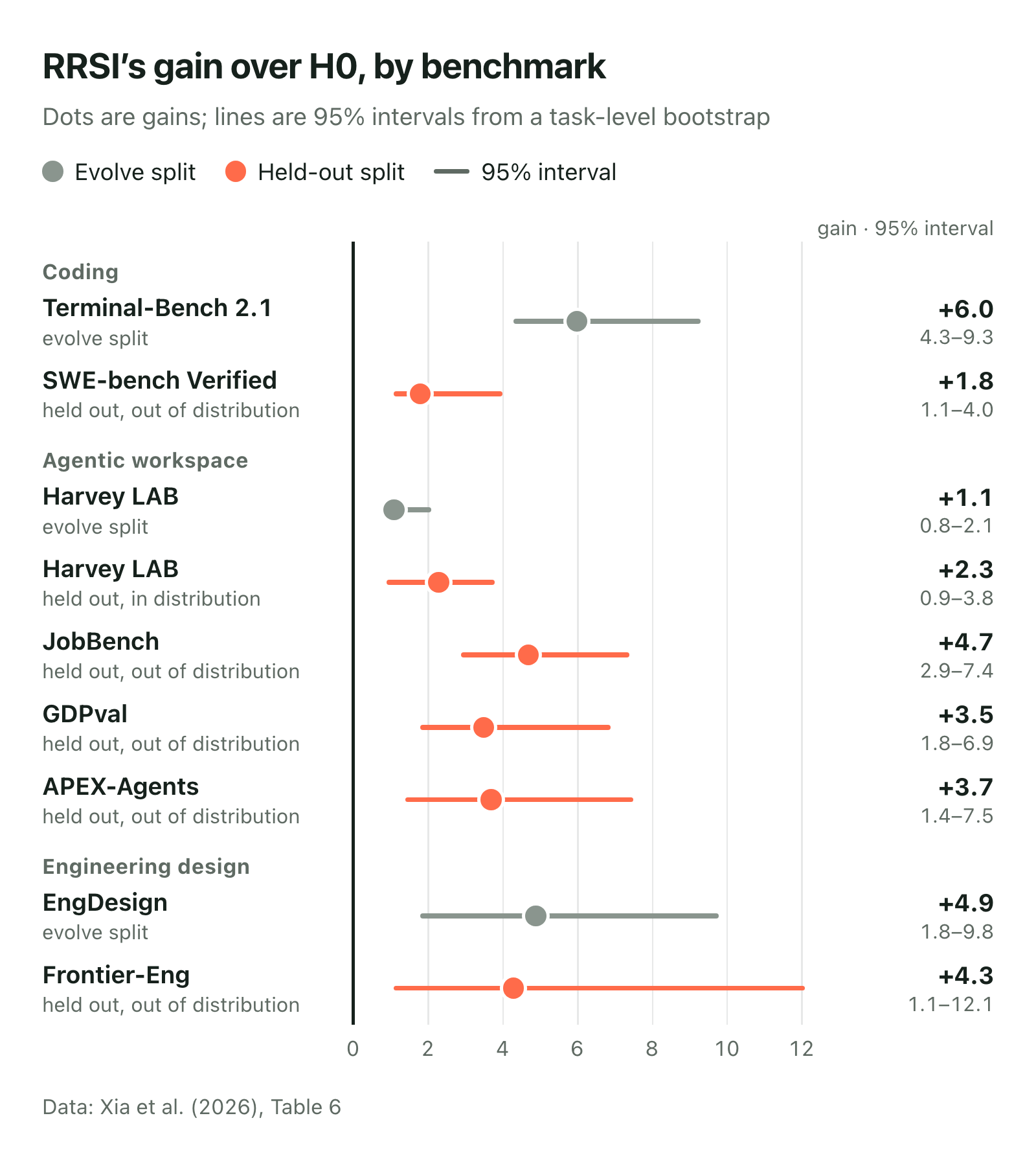
On the evolve splits, the gains were 6.0 points on Terminal-Bench 2.1 (74.2 to 80.2), 4.9 on EngDesign, and 1.1 on Harvey LAB, so the abstract’s “up to 6.0 points” compares against the starting harness. The held-out splits rose by 1.8 (SWE-bench Verified) to 4.7 points (JobBench) (Table 6). The 4.3 points the abstract gives as the out-of-distribution maximum is the Frontier-Eng value and is smaller than JobBench’s 4.7, so I’ve followed the tables. A paired bootstrap over tasks put every 95% interval above zero, and a repeated evolution run stayed within 1.8 points of the first everywhere (Tables 6 and 7).
What actually went into the harness is modest. On Harvey LAB, RRSI evaluated 32 candidates over 20 rounds and accepted only 4 edits, all attached to the check just before finishing. One re-checks coverage and depth, and three read the written file back and report facts such as a source value missing from it (Table 9).
Limits and open questions
In Appendix A, the authors note that they only study a frozen model, that RRSI still relies on a finite evolve set and several hyperparameters, and that broader validation is needed for other agent architectures and longer self-improvement runs. The setup leaves questions too. The critic is a model as well, and the policy, proposer, failure analyst, and critic are all Claude Opus 4.8, yet the paper doesn’t measure how often the critic’s verdicts are right. The total cost of the search isn’t reported either, and numeric comparisons with prior methods appear in tables only for the agentic workspace domain. As of November 2, 2026, it’s an arXiv preprint with no conference or journal listed.
Code and where to read next
Since the method trains no weights, there’s no model to release. The code is under the Apache 2.0 license, and the README pairs parts of the paper with files, such as the edit budget with rrsi/schedule.py and the critic with rrsi/critic.py. Its default setup calls Claude Opus 4.8 on Vertex AI and needs each benchmark’s own environment, so I only read the code. In the paper, I’d start with Section 3 and Tables 8 and 9 in Appendix F, and then the project page lets you step through the candidates, critic verdicts, and diffs of four real runs, round by round.
AI tools helped with the research for this post.